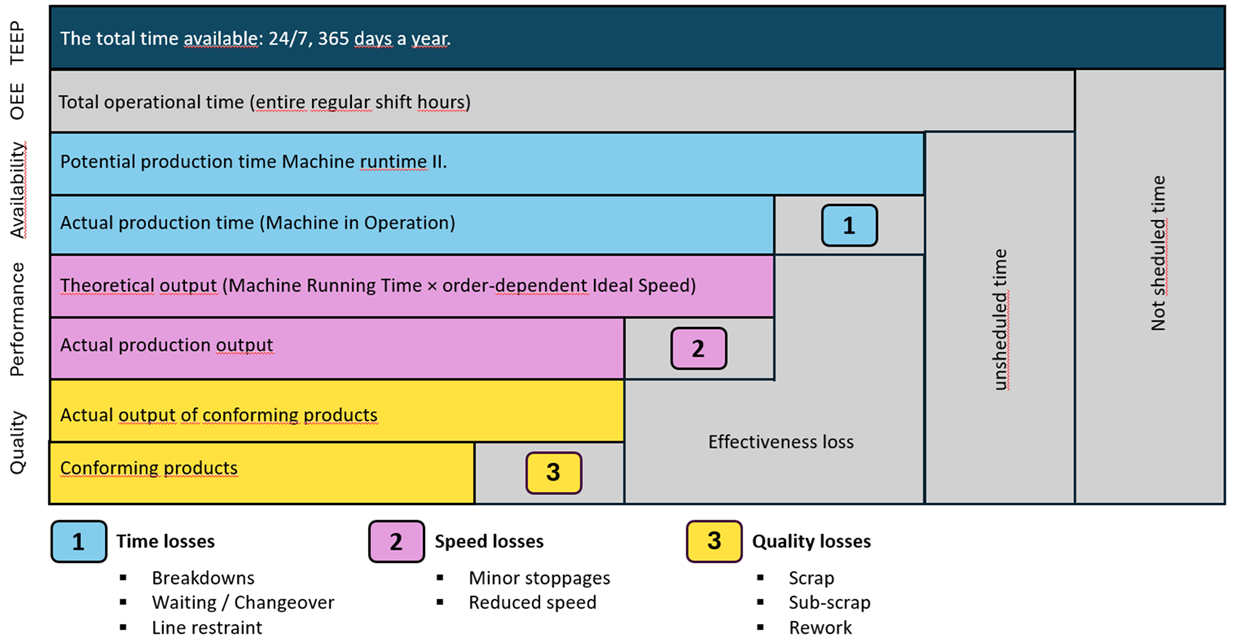
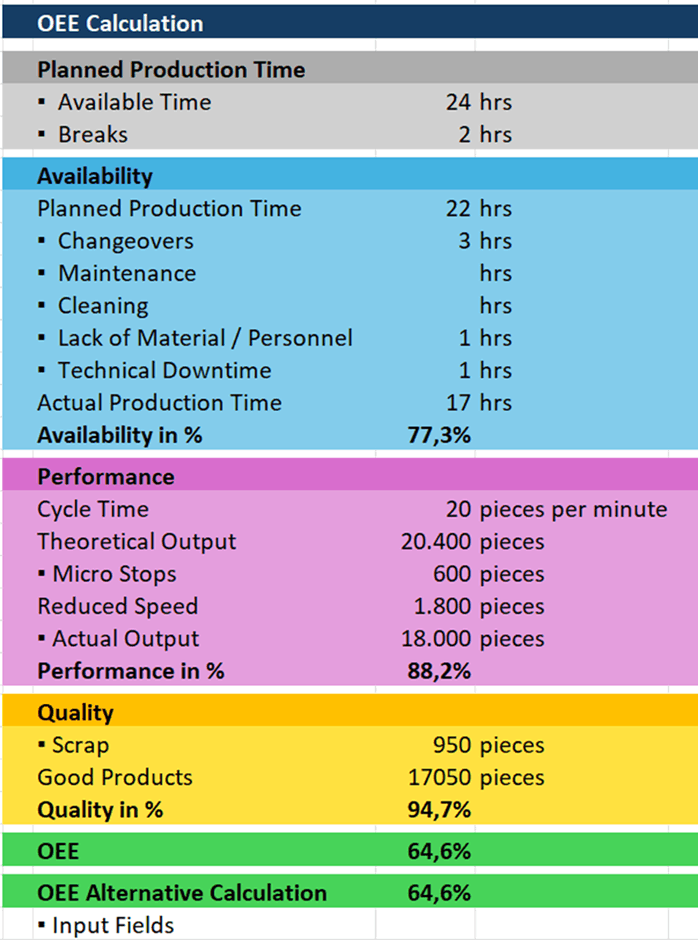
Overall Equipment Effectiveness (OEE) is a well-established KPI used to measure manufacturing efficiency. It describes how effectively a machine or production line is utilized during planned production time.
OEE is composed of three factors
Availability measures the ratio between actual operating time and planned production time.
Performance reflects speed losses compared to the ideal cycle time.
Quality represents the proportion of good units produced relative to total output.
OEE is calculated as the product of these three factors and is widely used in Lean manufacturing to identify losses, reveal unused capacity, and systematically improve production processes.
The classical OEE concept assumes that losses in availability, performance, and quality are primarily caused by production related inefficiencies.
This assumption holds true when products are similar and production conditions remain stable. In contract manufacturing and high mix environments, this is no longer the case.
Different products and variants intentionally require different setup times, speeds, and expected scrap rates. These differences are often the result of commercial decisions and are already reflected in pricing and costing.
When these planned effects are not separated from real production losses, classical OEE values lose their explanatory power.

Each production order is planned with its own expected values for
• setup time
• cycle speed
• quality level
These planned values reflect product specific characteristics and commercially accepted effects.
During execution, actual values are recorded for the same production order.
OEE is then calculated by comparing actual results against the planned values of that specific order.
Only deviations from the plan are considered production losses.
Planned effects resulting from product mix or commercial decisions are excluded from the performance evaluation.
Machine level OEE is derived by aggregating the OEE results of individual production orders over time.

The calculation of setup times is, in most cases, based on the differences between the specifications of the product to be manufactured and those of the previously produced item.
Depending on the flexibility of the machines and the variety of products, this can result in extremely complex calculations.
In practice, therefore, approximate values based on experience ("educated guesses") are often used, or only a limited number of key specification changes are captured in tabular form.
Testing or sample production is often required. These time requirements are exclusively the result of sales or management decisions and must be recorded here.
If the number of machine cycles must be reduced due to product specifications, this must be indicated in this field. The calculation should be performed using AI or statistical methods. Automation is necessary to minimize errors.
Lorem ipsum dolor sit amet, consectetur adipiscing elit. Curabitur in nulla ut magna vehicula libero luctus in ipsum consequat faucibus. Ut porta nulla ac dapibus convallis. Curabitur sit amet massa quam. In ut ex auctor, porta neque quis, sagittis purus. Nunc auctor gravida magna, sed efficitur tortor tristique quis.
If the scrap rate is determined exclusively by the production lot size, a linear or polynomial regression model is appropriate.
If additional factors influence the outcome, the application of artificial intelligence should also be considered.
These additional details enable an accurate assessment of actual production performance.

This model also enables additional transparency regarding strategically accepted losses resulting from sales and management decisions.
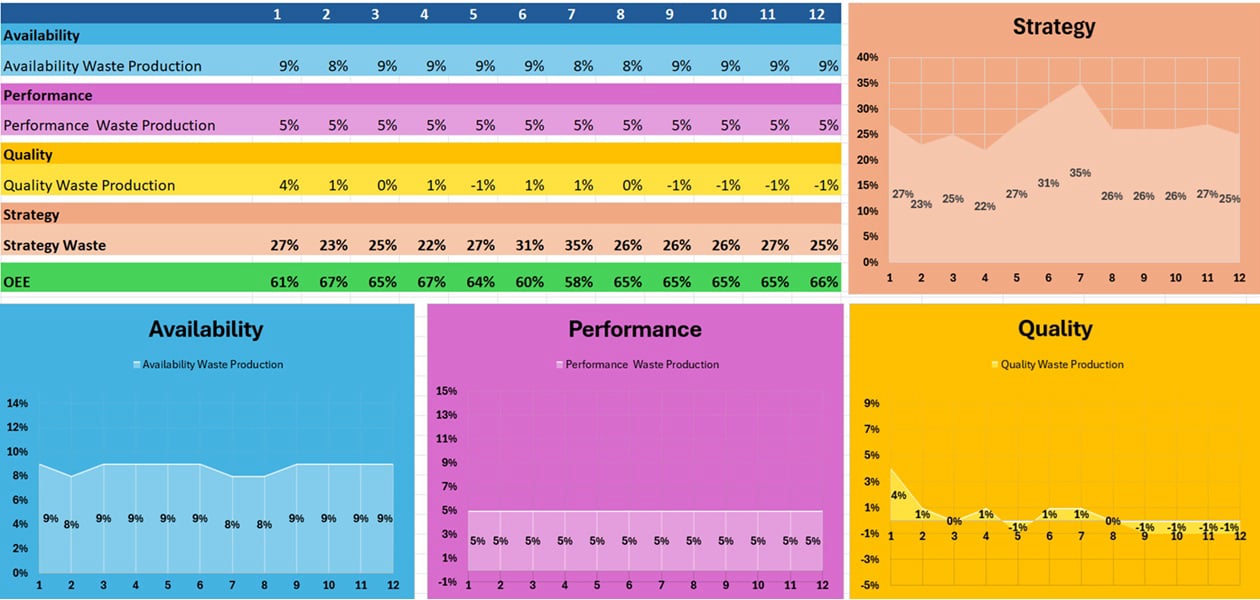
• This methodology requires a significantly higher effort.
• In theory, production-related losses can be negative (i.e., exceed 100%).
However, the planned losses resulting from sales or management decisions compensate for this accordingly, ensuring that the
overall value of the OEE components remains unchanged and cannot exceed 100%.
| Features | Classical OEE | OEE with high mix production |
|---|---|---|
| Production focus | Stable products and long production runs | Frequent product changes and variable batches |
| Planning logic | Based solely on machine capability | Dynamically adapts machine capability to specific production orders |
| Availability calculation | Based on planned runtime | Considers changeovers and the complexity of each order |
| Performance measurement | Ideal cycle time of the machine | Dynamically adapts machine cycle time by product specific and mix weighted factors |
| Quality evaluation | Uniform quality criteria | Product dependent quality requirements |
| Changeover handling | Treated as loss | Integrated as a core planning factor |
| Transparency | Machine centric view | Order and product centric view |
| Decision support | One view combining production and strategy | Separates production performance from strategic decisions |
| Compatibility | Established industry standard | Fully aligned with the classical OEE |
The classical OEE evaluates product performance and strategic planning decisions as a single combined result. As a consequence, it cannot accurately assess true production performance.
The modified OEE for high differences in lot sizes and product variety reflects real life responsibilities by clearly separating strategic decisions from operational execution. This separation makes both product related performance and production performance transparent and measurable on their own.